2018 Convention – Travel

Airfare Discounts | Arrival Instructions | Airport Bus | Taxi or Train | Attire | Business Hours | Climate | Currency | Electricity | Health | Insurance | Mobile Phones | Passport and Visas | Timezone | Tipping | Useful Phone Numbers | Foreign Embassies | Subway | Japan Departure
Delta Reservation Information
Contract Number: 429793 (Ver 2)
Meeting Ticket Designator/Meeting Code: NMRL5
Group Ticket Designator: NGJ96
Account Code: NMRL5
Minimum Number of Round Trip Passengers: 15 per meeting event flown on Delta Air Lines
Passengers must originate from two (2) or more cities
TRAVEL IN OR BETWEEN U.S./CA:
Discounts valid on Delta and applicable DL* Codeshare flights.
DELTA BOOKING CLASS PERCENTAGE OFF
F / J / C / D / Y / P / I 10%
B / M / H / Q / K / L 5%
U / T / V / X 2%
INTERNATIONAL DL*:
Travel allowed between Europe, Middle East, Africa, India, Caribbean, SJU,
STT, STX, Central/South America, Israel, Mexico, U.S. and Canada (does not
apply within/between U.S./CA). Discounts valid on DL and applicable DL*
Codeshare flights. Fare Class X / V discounts do not apply.
DELTA (DL) BOOKING CLASS PERCENTAGE OFF
J / C / D / W / Y / B / M 10%
I / Z / H / Q / K / L / U 5%
T 3%
INTERNATIONAL Transpacific Asia/Australia – US/CA DL*:
Travel allowed between Asia/Australia – U.S. and Canada. Does not apply
within/between U.S./CA). Discounts valid on DL and applicable DL* Codeshare
flights.
DELTA (DL) BOOKING CLASS PERCENTAGE OFF HANEDA JAPAN DISCOUNT
J / C / W / Y 20% 25%
D / I / B / M / H / Q / K 10% 15%
Z / L / U / T 5% 10%
X / V 3% 8%
By Phone: Reservations and ticketing is available via www.delta.com/meetings or by calling our Delta Meeting Network Reservations at 800-328-1111.
Online: When booking online at www.delta.com/meetings, select ‘Book Your Flight’ and enter your Meeting Code in the box provided.
Airlines:
Many major airlines fly directly into Nagoya. Delta offers a direct flight from Detroit. You can also fly into Tokyo’s Narita airport, but you will have to take a train from Narita to Tokyo Station, and then another train from Tokyo to Nagoya. Travel time on the trains is about 2-1/2 hours. Flying into Nagoya is much easier.
Arrival Instructions:
Upon debarking, follow signs to “Arrivals”. Walk across antigerm mat before entering immigration area. You must put both your index fingers in print reader. Then move to next station where you redo index fingers in print reader, they stamp and check your passport and take a photo. You must fill out debarkation card as well as custom card before entering this area, which is provided on the airplane. You need to know your hotel name, address, and phone for these cards. They keep one card at this station. Pick up your luggage. Next you move to final custom area where they ask questions about your reasons for being in Japan, check your passport, can ask to see your luggage, and take the final custom form. Then exit to arrival hall.
Airport bus:

Direct access to and from Chubu Centrair International airport and Nagoya city is provided by Centrair Limousine bus. The bus connects the airport to Meitetsu Bus Center in Nagoya station, Sakae, Fushimi and some main hotels in downtown. Our hotel, Nagoya Tokyu Hotel is the first stop on the bus after leaving the airport. It is also the last stop on the way back to the airport.
Travel time is about 45 minutes, runs every hour and is Bus Stop 6 at the airport . It runs to the hotel from 9:15 to 22:15. The return from the hotel to the airport is from 7:00 to 20:00. When you come out of the International Arrivals hall, you look for the signs for transportation, and follow to Centrair Limousine Bus Stop 6 Arrival Floor 2F.
More information at link below.
http://www.nagoya-info.jp/en/access/central_airport/acs_rbus.html
Fare: Adult 1,200JPY Child 600JPY (1200JPY = ~$12)

Taxi:
Taxi is about $135+ to our hotel. Might be useful if you have a group.
Train:
You would take the Meitetsu Line from the airport to Kanayama Station, then transfer to the Meijo Subway line, getting off at Sakae Station. Exit at East Wicket, down stairs, straight ahead, #12 exit. Walk about 3-1/2 blocks and hotel is on right. Trains run every 10-20 minutes. Cost is about 1200¥ total. Or you can take a taxi from Kanayama Station to hotel for about 2000¥.
Attire:
Business casual for meetings.
Business hours:
Banks are open from 9:00 to 17:00 Monday-Friday. Shopping: 9:00 to 21:00 Monday-Saturday, with earlier closing on Sundays. Restaurants are open similarly.
Climate:
Nagoya has a humid subtropical climate with hot summers and cool winters. The summer is noticeably wetter than the winter, although rain falls throughout the year. Average temperatures in November range from highs of 17°C (62.5°F) to lows of 8.1°C (46.6°F). Average rainfall for November is 79.7 mm (3.138 inches). Early November during the Convention is the Japanese fall season and is beautiful with fall leaf colors.
Currency:
The yen (¥) is the currency of Japan and banknotes and coins are identified easily. There are ¥1,000, ¥2,000, ¥5,000 and ¥10,000 banknotes; and ¥1, ¥5, ¥10, ¥50, ¥100 and ¥500 coins. Cash is the most widely used in Japan. However, major department stores and large hotels accept major credit cards. You can buy yen at Authorized Foreign Exchange banks, major post offices, international airports and other authorized money exchanger at hotels and department stores. The conversion from your currency to (¥) can be done at xe.com For example, $1 USD equals ~ 111 (¥). There is a currency exchange desk at the airport just after security, as well as an ATM. I suggest bringing a little local currency with you, at least to pay the bus transportation.
Most automated teller machines (ATMs) in Japan do not accept credit, debit or ATM cards issued outside of Japan. The big exception are the ATMs found at the over 21,000 post offices and at 13,000 Seven Bank ATMs throughout the country. ATMs at Post offices are available for this service, but only for those cards the sticker indicates. These ATMs at a post office allow you to withdraw cash by foreign Visa, Plus, MasterCard, Euro card, Maestro, Cirrus, American Express, Diners and JCB cards and provide an English user menu. ATMs at major post offices are typically available weekdays from 7:00 to 21:00 and closed on weekends, some may also open on Saturdays and Sundays. In addition to the ATMs at post offices, a small number of international ATMs are located in major department stores, airports and Citibank branches. In order to use international ATMs, make sure that your credit or debit card can be used abroad and that you know its PIN before leaving for Japan. SevenBank accepts Visa, Plus, Master card, Euro card, Maestro, Cirrus, American Express, Diners, JCB card and China UnionPay.
ATMs for Seven Bank can be found at Seven-Eleven convenience stores nationwide, and nearly all are conveniently accessible 24 hours a day. Also, check what fees and daily and/or monthly limits are associated with international withdraws.
Electricity:
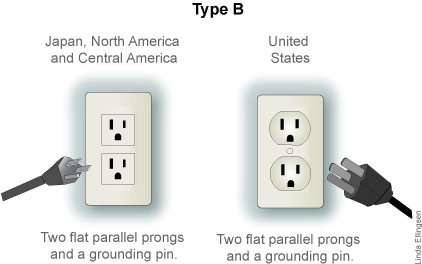
The voltage in Japan is 100 Volt, which is different from North America (120V), Central Europe (230V) and most other regions of the world. Japanese electrical plugs have two, non-polarized pins, as shown above. They fit into North American outlets.
Health:
No immunizations are required to enter Japan, but generally it is a good idea to make sure your tetanus, diphtheria and polio vaccinations are up to date before traveling. You can also check with your personal doctor to see if they recommend anything.
Insurance:
The Society of Wood Science and Technology is not responsible for the insurance of participants against personal injuries, sickness and theft or property damage incurred during the convention period. Concerned participants should obtain insurance coverage.
Mobile phones:
While most newer mobile phone models can be used in Japan, many older phones may not work due to different technologies. Most importantly, there is no GSM network in Japan, so GSM-only phones do not work. You can buy prepaid SIM cards if your phone accepts them. You can also rent/buy temporary cell phones. One example of cell phone rental/purchase: www.mobal.com
Passport & Visa:
As of July 2017, Japan has taken measures concerning the Visa Exemption Arrangements with 68 countries and regions as the chart below.
Nationals and citizens of those countries and regions shown below are not required to obtain visas to enter Japan when their visits are tourism, commerce, conferences, visiting relatives/acquaintances, etc. However, when foreign nationals engage in paid activities in Japan, or their periods of stay exceed those stipulated in each country’s arrangement of short-term stay, visas will be required to enter Japan.
- Period of Stay: The period of stay granted at the time of the landing permission will be “15 days” for Brunei, Indonesia, and Thailand, and “30 days” for United Arab Emirates and “90 days” for other countries and regions.
| Asia | Europe |
|---|---|
| Brunei (15 days) | Andorra |
| Indonesia ([Note1]) | Austria([Note8]) |
| Malaysia ([Note2]) | Belgium |
| Republic of Korea | Bulgaria |
| Singapore | Croatia |
| Thailand ([Note3])(15 days) | Cyprus |
| Hong Kong([Note4]) | Czech Republic |
| Macao([Note5]) | Denmark |
| Taiwan([Note6]) | Estonia |
| North America | Finland |
| Canada | Former Yugoslav Republic of Macedonia |
| United States | France |
| Latin America and the Caribbean | Germany([Note8]) |
| Argentina | Greece |
| Bahamas | Hungary |
| Barbados([Note7]) | Iceland |
| Chile | Ireland ([Note8]) |
| Costa Rica | Italy |
| Dominican Republic | Latvia |
| El Salvador | Liechtenstein([Note8]) |
| Guatemala | Lithuania |
| Honduras | Luxembourg |
| Mexico([Note8]) | Malta |
| Surinam | Monaco |
| Uruguay | Netherlands |
| Oceania | Norway |
| Australia | Poland |
| New Zealand | Portugal |
| Middle East | Romania |
| Israel | San Marino |
| Turkey([Note7]) | Serbia |
| United Arab Emirates([Note9]) | Slovakia |
| Africa | Slovenia |
| Lesotho([Note7]) | Spain |
| Mauritius | Sweden |
| Tunisia | Switzerland([Note8]) |
| United Kingdom([Note8]) |
- ([Note1]) For nationals of Indonesia (since December 1, 2014), visas are not required only for those who have registered ICAO-compliant ePassport to diplomatic missions of Japan in Indonesia (the embassy, consulates-general, or the consulate). Validity of the registration is three years period or until the passport expires, whichever comes first.
- ([Note2]) For nationals of Malaysia (since July 1, 2013), visas are not required only for holders of ePassport in compliance with ICAO standards. Those who do not hold such ePassport are advised to obtain a visa in advance, otherwise will be strictly examined and may be refused entry to Japan.
- ([Note3]) For nationals of Thailand (since July 1, 2013), visas are not required only for holders of ePassport in compliance with ICAO (International Civil Aviation Organization) standards.
- ([Note4]) For citizens of Hong Kong, visas are not required only for holders of Special Administrative Region (SAR) passport issued by the Hong Kong SAR of the People’s Republic of China or British National Overseas (BNO) passports who have the right of residence in Hong Kong.
- ([Note5]) For citizens of Macao, visas are not required only for holders of SAR passport issued by the Macao SAR of the People’s Republic of China.
- ([Note6]) For citizens of Taiwan, visas are not required only for holders of Taiwan passport which includes a personal identification number.
- ([Note7]) For nationals of Barbados (since April 1, 2010), Turkey (since April 1, 2011) and Lesotho (since April 1, 2010), visas are not required only for holders of Machine-Readable Passport (MRP) or ePassport in compliance with ICAO standards. Those who do not hold an MRP or ePassport are advised to obtain a visa in advance, otherwise will be strictly examined and may be refused entry to Japan.
- ([Note8]) For nationals of those countries with visa exemptions permitting stays of up to 6 months under the bilateral visa exemption arrangements, those who wish to stay in Japan for more than 90 days are required to apply for an extension of the period of stay to the Ministry of Justice (Regional Immigration Bureau) before the period of permitted stay is to expire.
- ([Note9]) For nationals of the United Arab Emirates (since July 1, 2017), visas are not required only for those who have registered ICAO-compliant ePassport to diplomatic missions of Japan (the embassy, consulates-general, or the consulate). Validity of the registration is three years period or until the passport expires, whichever comes first.
- ([Note10]) Nationals of Peru (since July 15, 1995) and Colombia (since February 1, 2004), are advised to obtain a visa in advance, otherwise will be strictly examined and may be refused entry to Japan.
Time Zone:
UTC/GMT +9 hours
https://www.timeanddate.com/worldclock/japan/nagoya
Tipping:
Tipping in Japan is not customary.
Useful Telephone Numbers:
Country code: 81 Check your particular dialing codes
Dial 119 for fire department or medical services
Dial 110 for police
Foreign Embassy Contact Addresses in Nagoya:
https://www.embassypages.com/city/nagoya
SUBWAY:
The Nagoya subway includes six lines: Higashiyama, Meijo, Meiko, Tsurumai, Sakuradori, and Kamiida. The Meijo line (purple) is a loop and connects to all other subway lines at Sakae, Kanayama and elsewhere, making it a convenient way to get around the city. Nagoya University (stop Nagoya Daigaku) is on the Meijo line. The main tourist attractions in the city are within walking distance of the subway.
Our hotel, Nagoya Tokyu Hotel, is on the Higoshiyama line (yellow), and the closest stop is Sakae.
Subway fares range from ¥200 (¥100 for child under 12 years) for one zone to ¥330 (¥160 for child under 12 years) for five zones.
The best way to use the subway is to get a Manaca card.  It is a hard card (similar to a credit card) and you can load as much money on as you want. You just tap it on the subway entrance and exit. You do need to put a ¥500 deposit on it (about $5) but you can get it refunded at the airport on your departure. We will be using the subway each day to get from the hotel to the University, for a daily cost of about ¥500. We will also use it to get to the Keynote Session and Welcome Reception on Monday for the same price. I would suggest you put $30 on it to start (this includes the deposit). It can be used in Nagoya as well as several other cities (Kyoto for sure), and on the JR train lines. It can also be used at some convenience stores for purchases.
Please try to have your card purchased before we leave the hotel on Monday to go to the Keynote Session. This will minimize the time needed in the station. You can check with the registration desk on Sunday evening in the Hotel Lobby from 17:00 to 19:00 if you have questions or need help.
The machines in the subway station are very easy to use and have an “English” button.
You choose “English”, then Manaca Card, add the amount you want, and it dispenses the card.

Our hotel is located in the Sakae area, which is the downtown central area of Nagoya, with lots of restaurants and shops. Sakae Area Map
On the weekend or if you are staying in Nagoya additional days, you may want to get a weekend ticket (Donichi Eco Kippu) or a 1-day ticket if you plan to go to take more than 2 trips a day. The 1 day pass for a day of unlimited rides on city buses and the subway (which costs ¥850 for adult,¥430 for child under 12 years for both bus and subway, or ¥740 for adult, ¥370 for child under 12 years for just the subway), and the Donichi Eco Kippu ticket (¥600 for adult,¥300 for child under 12 years), which allows unlimited rides on city buses and the subway on weekends, public holidays, and the eighth of each month (Environmental Conservation Day).
You also get a discount for tourist spots when you show either of these two tickets. Different tourist facilities offer differing discount rates. A total of 37 tourist facilities offer discounts. Check this page for details!
Toku-Navi (Advantageous info! Check this out!)
- Nagoya Castle
- Higashiyama Zoo and Botanical Gardens
- Higashiyama Sky Tower
- Shirotori Garden
- Tokugawaen
- Tokugawa Art Museum
- Hori Art Museum
- Yamazaki Mazak Museum of Art
- Hosa Library
- Ran-No-Yakata
- Cultural Path Futaba Museum
- Cultural Path Shumokukan
- Nagoya TV Tower
- Nagoya City Museum
- Nagoya City Art Museum
- Nagoya City Science Museum
- Nagoya/Boston Museum of Fine Arts
- Toyota Commemorative Museum of Industry and Technology
- Noritake Garden
- Nagoya Port Wildflower Garden Bluebonnet
- Furukawa Art Museum and Tamesaburo Commemorative Hall
- Daiichi Museum
- Kuwayama Museum
- Showa Museum
- Mandolin Melodies Museum
- Art Café Sakae, Morimura Museum
- Atsuta Jingu Treasury Hall
- Arimatsu Tie-Dying Museum
- Port of Nagoya Public Aquarium
- Nagoya Port Building Observation Deck
- Nagoya Maritime Museum
- Antarctic Observation Ship Fuji
- Aichi Prefectural Museum of Art
- Nagoya Port Sea Train Land
- Togokusan Fruits Park
- Peace Aichi
- Aichi Prefectural Ceramic Museum
*Entrance fee discounts are limited to one person per ticket, and only for the day the ticket is valid. Students and senior citizens should present proof of age at the ticket window for each tourist facility.
Japan Departure:
One thing to note is that the airline counters to check-in only open 3 hours before your flight leaves, so you need to plan accordingly. Otherwise you are there too early and waiting around with your luggage. There are lots of stores and food shops outside security so you can waste time that way. Security is normal with taking out computers and liquids in quart bag, but you keep shoes on. Once you are through security line, you go to immigration where they look at your passport and boarding pass. If you bought any tax-free items (some stores offer this option if over a certain price), the store attaches a receipt for your purchases into your passport and you put that in a box before going through immigration. You deposit the store receipt in the box but leave the other form in your passport and they take it at immigration. Once you are through immigration there are stores, restaurants, and airline lounges (if you have access). Delta doesn’t have a lounge but you use Korean Airlines Lounge. There is extra security at the gate so you should not wait until the last minute.