#SWSTIC #SWST2020 Keynote
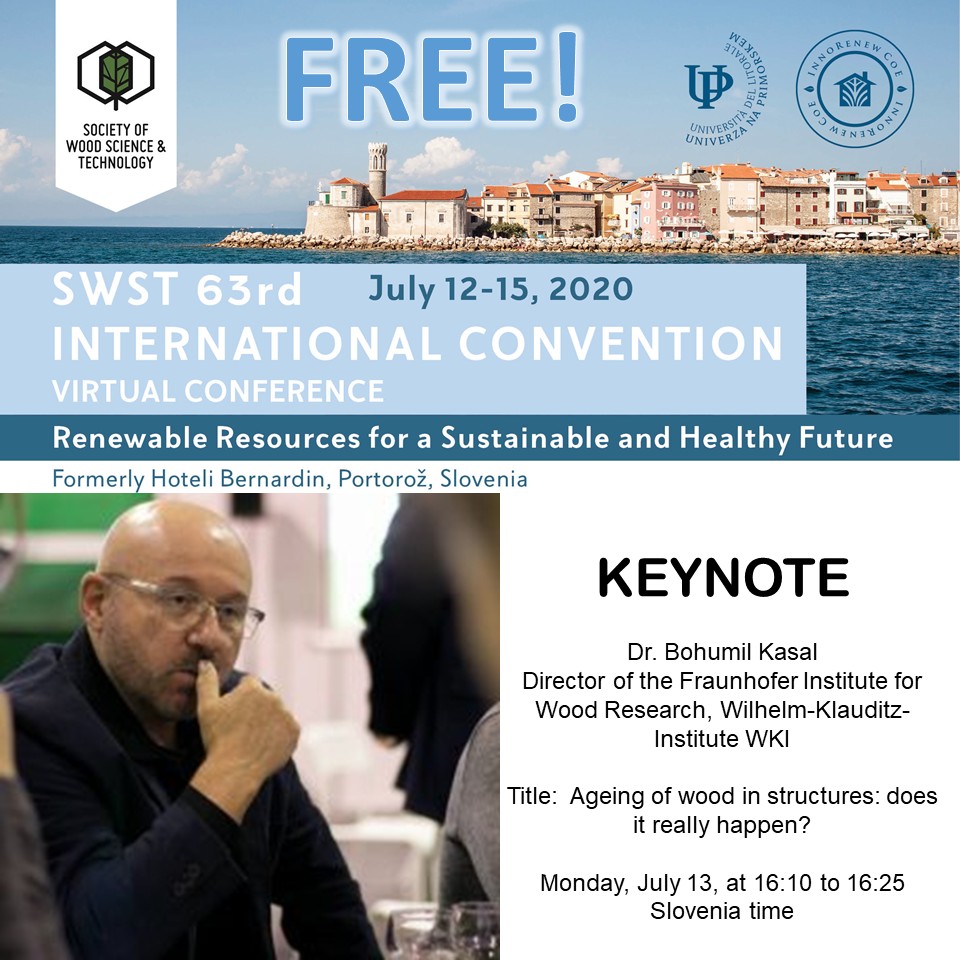
Ageing in general is a process or permanent, irreversible change of relevant properties with time. This definition is applicable to many scenarios and the term relevant properties is of the key importance. To study the ageing (or causes of ageing) is practically impossible in the context of structural materials that are intended to be used sometimes for centuries. Accelerated methods are often used to predict the change of materials properties with time and often, extrapolation is used to do so. Direct validation of accelerated methods to simulate processes of ageing is virtually impossible. This presentation will attempt to shed the light onto the mystery of ageing of wood.
A little bit about our keynote speaker:
Dr. Bohumil Kasal graduated in 1980 from the Technical University Zvolen in Slovakia with the engineering degree (Ing.) in Wood Technology. Between 1980 and 1987 he worked at the State Wood Research Laboratory in Bratislava, Department of Physics as a Research Engineer. Between 1987 and 1989, Dr. Kasal worked at the area of wood composites at Virginia Polytechnic Institute and State University in Blacksburg, USA and received a MS degree in Sustainable Biomaterials. He then moved to Oregon State University (1989-1992) where he worked as a Research Associate and received a MS degree in Civil and Environmental Engineering (Structures) and PhD degree in Renewable Materials with minors in Applied Mathematics and Structural Engineering. In 1992 he worked at Alpine Engineered Products, Inc. in Pompano Beach, Florida as a Research and Development Engineer. Since 1992, Dr. Kasal was an Assistant Professor, Associate Professor and Professor at the North Carolina State University in Raleigh, NC at the Department of Wood and Paper Science. He also held a faculty position at the department of Civil and Environmental Engineering. At NC State, Dr. Kasal´s work focused on engineering applications of wood, relations between genetic markers and wood properties, and methods for the in-situ evaluation of timber. Dr. Kasal´s work in historic timber evaluation was presented by the US National Science Foundation in its budget request to the Congress of the United States in 2005 as one the examples of a successful international research. Dr. Kasal´s research on light-frame wood structures under natural hazard loads was discussed in various media networks such as ABC, NBC or NBC International, and in 2001-2002, Dr. Kasal was a Senior Fulbright Scholar and Visiting Professor in Dresden, Germany. During that time, he led an EU research project on seismic performance of timber frames that was featured by the EU as an example of a successful team research.
In 2005, Dr. Kasal was named the Bernard and Henrietta Hankin Chair of Residential Building Construction at the Pennsylvania State University at University Park, PA – a prestigious endowed chair position. He was also appointed a Professor of Architectural Engineering and a Professor of Civil and Environmental Engineering, and directed the Pennsylvania Housing Research Center. At Penn State, Dr. Kasal conducted research on low-rise buildings subjected to wind loads and directed international research on timber structures under seismic loading and composite wood structures. He taught courses in wood mechanics, wood composites and the design of timber structures. Dr. Kasal held honorary appointments at the University of Bristol, UK and University of New Brunswick, Canada, adjunct Professorship at the North Carolina State University, USA and he is a Professor at the Czech Technical University in Prague, Czech Republic and Professor at the University of Primorska, Slovenia.
In 2010, Dr. Kasal was selected to be the Director of the Fraunhofer Institute for Wood Research, Wilhelm-Klauditz-Institute WKI. At the same time, he was appointed as a Professor of Organic and Wood-based Construction Materials at the Technical University of Braunschweig.
Kasal is a member of the American Academy of Mechanics, American Society of Experimental Mechanics, Society of Wood Science and Technology and a number of other professional societies and editorial boards and has authored over 200 publications. He is also accredited as a professional engineer in the area of diagnostics and building evaluation. In 2011 he was elected a Fellow of the International Academy of Wood Science and in 2017 a Member of the American Society of Civil Engineers.