About Portoroz Area
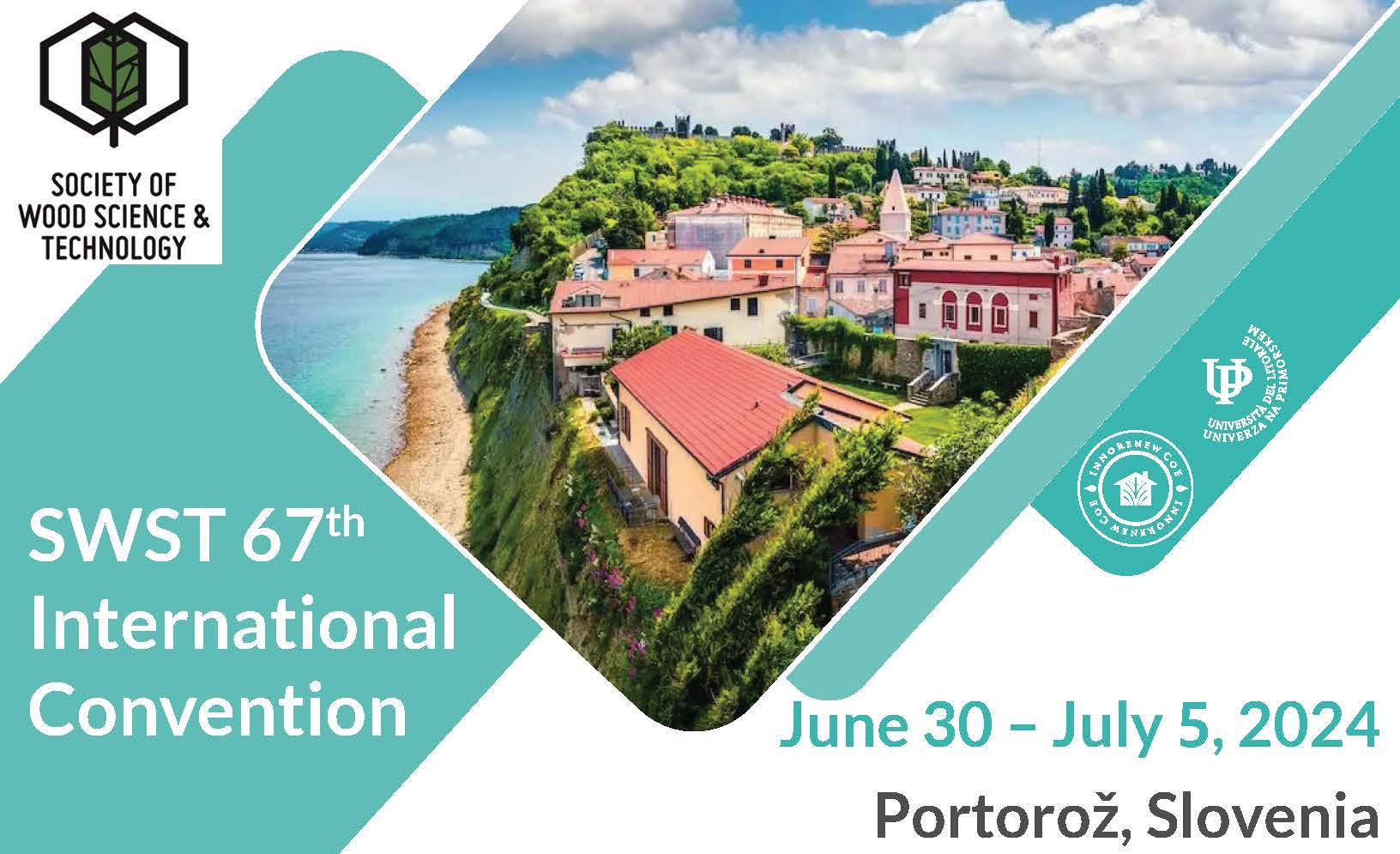
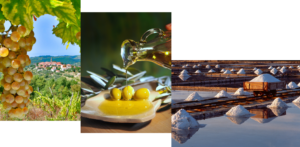
Along the Adriatic coast we find the Slovenian Istria area where Wine, Olive, and Salt are harvested and shared with the world. The cities below make up this region.
Portorož:
 Portorož is a resort town on Slovenia’s Adriatic coast. Its spas offer therapeutic treatments based on the mud and brine from the nearby Sečovlje Salina salt pans. Portorož and Piran are surrounded by salt pans on both sides. The high value of the famed salt enabled the rise of picturesque Piran in medieval times. Salt makers produce salt following a 700-year old procedure and still harvest it manually with traditional tools.
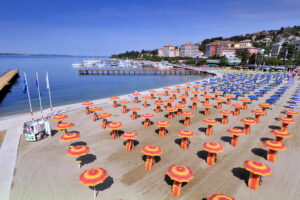
The central Portorož Beach is a wide, sandy stretch with wooden piers. Spas, boat excursions and other waterborne activities are Portorož specialities. Diving is possible, while guided snorkelling trips are also an excellent, easy way to explore the underwater marine environment.
South of Portoroz is Forma Viva – an open air sculpture exhibition. The open air sculpture exhibition was started by Slovenian artists Jakob Savinšek and Janez Lenassi in 1961. It has now been open continuously for 50 years during which masons from more than 30 different countries have contributed more than 130 stone sculptures. The exhibition is surrounded by the indigenous olive trees of Piran and features a breath taking view over Portorož Bay and its surroundings.
The hilltop Church of St. Bernardin is a former monastery from the 15th century. The remains of the former monastery comprise a well-preserved and eminent bell tower, the church presbytery and the retaining wall complete with arches. The monastery and the church date back to the 15th century and are dedicated to St Bernardine of Siena. Activities in the monastery ended in the 19th century and the Austrian military later used the complex as a stronghold, from which soldiers defended the bay. Later, the building was the seat of the tax administration as well as the customs office. The ruins are part of the Bernardin Resort.
Valeta Tunnel Parenzana: The path of friendship and good health follows the old, 123km long, narrow gauge train track, which connected Trst and Poreč and the inland cities of the Istrian peninsula. The path offers many sports activities and brings together people who enjoy walking, running or cycling. The path takes you through cities and villages, sometimes following the coastline right by the sea, other times leading you through vineyards and olive tree plantations, short and well-maintained tunnels and into valleys and hills. All the tunnels are still well-preserved, the most famous one among them being the Valeta Tunnel, a 550m long tunnel that connects Strunjan and Portorož.
The Fonda fish farm is the only sea fish farm in Slovenia. There, in the clean waters in middle of the sea of this fishing reserve, European basses and Mediterranean mussels are raised. Its uniqueness in Slovenia and the popularity of the “Piranski brancin Fonda” (Fonda European Bass from Piran) trademark, have caused the fish farm to become an international tourist location. They offer an interesting and unforgettable experience to all sea- and sea-food-lovers, as well as guided tours of the facilities.
Magazen Grando and Monfort Salt Warehouses: The warehouses are marked by a monolith featuring a heron made by sculptor Vladimir Makuc that stands in front of them. They both date back to the first half of the 19th century. The buildings are of a simple but robust and imposing design. Their main characteristics are 2.5m thick walls and 28m long joists and even longer wooden frames above them (the longest in Slovenia), made out of a single piece of wood. After the salt season ended, workers moved their yearly harvest from their houses into these warehouses. Today Monfort houses two exhibitions of the Maritime Museum – »Traditional Shipbuilding« and »The Evolution of Water Sports«. It is also a gallery hosting many exhibitions of modern art.
Holy Church of Our Lady of the Rosary, Portorož: This parish church was consecrated in 1984. It’s a modern building, boasting a cross and a roof profile that are reminiscent of a ship and its mast. Inside you can admire an altar sculpture made of baked clay, vividly coloured stained glass and oil paintings depicting the Way of the Cross.
Piran:
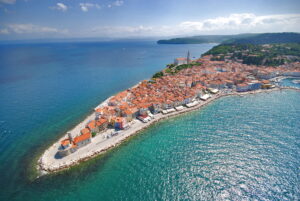 Piran is a resort city on Slovenia’s Adriatic coast, known for its long pier and Venetian architecture. For 500 years, from 1283 to 1797, Piran was part of the Republic of Venice. After 1797, Piran bounced back and forth between Austrian, French, and Italian rule and in 1954 it became part of Yugoslavia. Since 1991, Piran is part of Slovenia. Until the mid 20th century, Italian was the official language. Much of the architecture and food in Piran have very strong Italian influences. If you look on a map, it is just a short drive to Trieste, Italy and not much farther away is Venice.
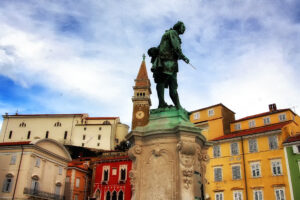 Tartini Square is the main square in Piran. It is named after Guiseppe Tartini, an Italian composer and violinist, who was born here and you can visit his frescoed Tartini House.On three sides, colorful buildings surround the square. The fourth side of the square opens up to the harbor. Until the end of the 19th century, the square was filled with water and this was part of the original port. In 1894, platforms were added and more buildings were constructed, forming the square as we see it today. The 19th-century town hall has a stone lion, a symbol of the former Republic of Venice.
Behind Tartini Square is the Church of St. George which has 17th-century paintings and marble altars. Modeled after St. Mark’s Cathedral in Venice, this church is a great spot to get unique views over Piran and the coast. From the yard that surrounds the church, you can look down at the small slivers of rocky beaches that surround the old town. Off in the distance, you can see the Italian and Croatian coastlines.
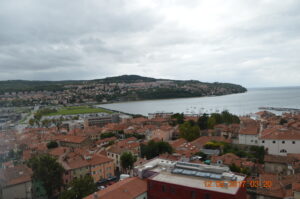
For the best view of Piran, climb the bell tower. It is 146 rickety steps to the top and your reward is a 360° view over Piran, Slovenian Istria, Italy, and Croatia. This is the best spot to get an aerial view of Tartini Square.
Walls of Piran: For another unique view over Piran, you can walk a short stretch of medieval walls. It is an uphill walk to get here, and it can be very hot in the summer months, but it is worth it for this view. While Piran was part of the Republic of Venice, these fortifications were built to protect the town from Turkish invasions. These walls date back to the late 15th century.
The most popular item on the menus in Piran is seafood. Take your pick from a number of great restaurants in town.
Izola:
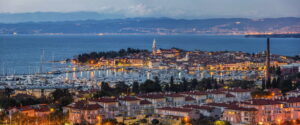
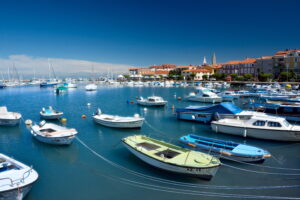 Izola is an old fishing town with a rich history. The latin name for island is ‘izola’ and Izola used to be an island that was connected to the mainland by a stony bridge. Established by refugees from Aquileia in the 7th century, the town was once surrounded by a wall, which was pulled down at the beginning of the 19th century, the material used to cover the sea between the island and mainland.
Most importantly, it is the future home of InnoRenew!
The largest Italian ocean liner of the day, the legendary Rex, was sunk off the coast of Izola during WWII. Izola is part of the EU project Little Boat, which connects Izola with Slovenian and Croatian destinations in Istria and Kvarner.
Besenghi degli Ughi Palace: Izola’s most beautiful building is this late-baroque palazzo below the Parish Church of St Maurus (This renovated, salmon-coloured, 16th-century church and its detached bell tower are on the hill above the town. The views are the main reason to climb up here, but take a peek inside if it’s open.). Built between 1775 and 1781, the mansion has windows and balconies adorned with stuccos and wonderful wrought-iron grilles painted light blue. It is now a music school.
The best beach close to Izola is at Simon’s Bay, about 1.5km to the southwest. It has a grassy area for sunbathing.
The Venetian Gothic Manzioli House was built in 1470 and was the residence of an Istrian chronicler in the 16th century. Today it houses the bureau looking after the interests of the communità italiana(Italian community) in Izola – and a wine bar.
Church of St Mary of Haliaetu: This central church dates from around the latter 11th century and has been lovingly restored. It has no set opening times, but is generally left open during daylight hours.
Koper:
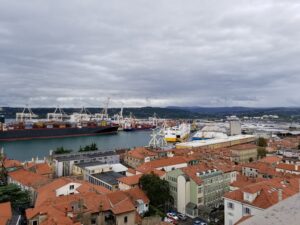 Koper is a town of a hundred suns which adorn the medieval Venetian palaces. It is a port city in Slovenia, on the country’s Adriatic coastline. Koper is Slovenia’s main cruise ship port and is located just a few miles from the city of Trieste, Italy. First established during the Roman Empire, the port of Koper has played an important role in the development of the area. It is among the largest in the region and is one of the most important transit routes for goods heading from Asia to central Europe. In contrast with other European ports, which are managed by port authorities, the activities of the Port of Koper comprise the management of the free zone area, the management of the port area, and the role of terminal operator. Its medieval old town centers around Titov Trg, a square with Venetian-influenced landmarks such as the Praetorian Palace and a Gothic-style loggia, while nearby Da Ponte Fountain is a replica of Venice’s famed Rialto Bridge. Rebuilt many times, the circa-12th-century Cathedral of the Assumption features a tall campanile with sweeping bay views.
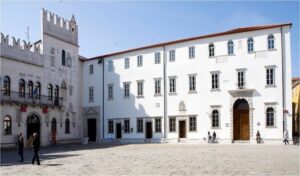
In the centre of old Koper, Titov trg is a Venetian-influenced stunner; mercifully, like much of the Old Town’s core, it is closed to traffic. On the north side is the arcaded Venetian Gothic Loggia built in 1463 (a perfectly placed cafe lives here); attached is the Loggia Gallery, with changing art exhibits. To the south is the Praetorian Palace, once the symbol of Venetian power in the region. On the southern side of Titov trg is the white Praetorian Palace, a mixture of Venetian Gothic and Renaissance styles dating from the 15th century and the very symbol of Koper. Now serving as the town hall, it contains a reconstructed old pharmacy and the tourist information office on the ground floor, plus exhibits on the history of Koper and a ceremonial hall for weddings on the 1st floor. Access is via guided tour. The facade of the palace, once the residence of Koper’s mayor who was appointed by the doge in Venice, is festooned with medallions, reliefs and coats of arms.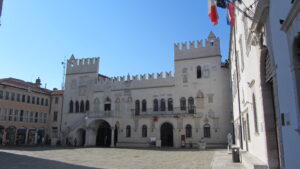
On the square’s western side, the Armoury was a munitions dump four centuries ago and is now university offices. Opposite is the Cathedral of the Assumption and its belfry. The Cathedral of the Assumption of the Blessed Virgin Mary stands in the location of a former ancient building – a Roman basilica. The history of the Cathedral goes back to the 12th century, when the city acquired its own diocese. Today’s front combines Gothic (the lower part) and Renaissance styles (the upper part). The Cathedral keeps numerous treasures: the big altar painting “Madonna with Child on the Throne and Saints”, painted by Vittore Carpaccio in 1516, the stone sarcophagus of Koper’s patron saint, St. Nazarius from the 15th century, etc. Town tower in Tito square, once romanic forticication, became a bell tower in 15th / 17 th century. It houses one of the oldest bells in Slovenia, dating back to 1333. From the panoramic point (43 metres and 204 climbable stairs) you can see the nearby and distant surroundings of the city Koper. Tickets are sold at the tourist information centre on the square.
Prešernov trg: The square is lined with colorful buildings. The 17th-century Italian family who erected the fountain in Prešernov trg was named Da Ponte; thus it is shaped like a bridge (ponte in Italian). The fountain that looks much like a miniature version of Venice’s Rialto Bridge. At the square’s southern end is the Muda Gate. Erected in 1516, it’s the last of a dozen such entrances to remain standing. On the south side of the archway you’ll see the city’s coat of arms with a radiating sun, the face of a youth in a sunburst. This was once the main gate of the old city wall, and visitors had to pay a toll to enter.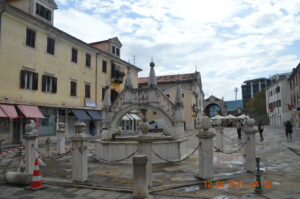
One of the most colourful streets in Koper, Kidričeva ulica, starts at Carpacciov trg, where the Column of St Justina commemorates Koper’s contribution – a galley – to the Battle of Lepanto in which Turkey was defeated by the European powers in 1571. Just north is a large Roman covered basin that now serves as a fountain. The western edge of the square is marked by the large arched Taverna, a one-time salt warehouse dating from the 15th century.
Atmospheric Čevljarska ulica, a narrow commercial street for pedestrians, runs south from Titov trg. As you walk under the arch of the Praetorian Palace, look to the right. The little hole in the wall with the Italian inscription ‘Denontie’ was where anonymous denunciations of officials could be made. At the end of Čevljarska ulica and down the stone steps is the Almerigogna Palace, a painted Venetian Gothic palace (now with a very basic pub on ground level). It’s one of Koper’s most beautiful buildings, despite the severely faded paintwork. Look high to see the colour remaining under the eaves.
Fontico: On the eastern side of Trg Brolo is the Fontico, a granary where the town’s wheat was once stored, with wonderful medallions and reliefs adorning the facade.
Koper Regional Museum: The 17th-century Belgramoni-Tacco Palace houses the Koper Regional Museum, whose history collection spans prehistory to more recent times. In beautiful surrounds is art dating from the 15th century, and displays of armoury and musical heritage.
 University of Primorska has its home in Koper. The mission of the University of Primorska is to carry out education and scientific research in a professional and creative manner and to support the balanced development of Slovenia in the region, Europe, and globally. Its activities are in line with the national programme for higher education, the national research and development programme, strategic documents of the Republic of Slovenia, and guidelines for the development of a common European higher education and research area, with a particular emphasis on the Mediterranean region. Studies at the University of Primorska are organised at 6 faculties: the Faculty of Humanities, the Faculty of Management, the Faculty of Mathematics, Natural Sciences and Information Technologies, the Faculty of Education, the Faculty of Tourism Studies Portorož – Turistica, the Faculty of Health Sciences, and the Faculty of the Built Environment. Around 6000 students are enrolled in the 74 study programmes of the University of Primorska. Faculties of the University of Primorska offer high-quality, diverse, and engaging studies. Scientific research at the University of Primorska is carried out at all faculties and at the research institute, which is unique among Slovenian universities. The University has 16 registered research groups with more than 500 researchers. Research and development work is conducted in the following areas: social sciences, humanities, natural sciences, technical sciences, medical sciences, biotechnical sciences, and interdisciplinary research.
Taverna Koper: The Taverna is a former salt warehouse (St Mark Salt Warehouse) constructed at the end of the 16th century. Today Taverna is a venue for numerous events.
Carpaccio square: This part of the city often features a farmer’s market, flea market, and/or food fair. This open air market features all sorts of Slovene antiques and flea market items. An outdoor food fair is often held in the Carpaccio Square, which is next to the old St. Mark’s salt drying warehouse. Locals and visitors eat at tables in the old open-air salt drying warehouse next to on the harbor. All kinds of tempting foods are available in the booths such as international delicacies from around the world–falafels, burritos, barbecue pork, Asian noodles, and Turkish dishes.
The Rotunda of St John the Baptist: Behind the Cathedral of the Assumption to the north is a circular Romanesque Rotunda of John the Baptist, a baptistery dating from the second half of the 12th century with a ceiling fresco.
 There are is a public beach in the sea just west of the marina. A large sports area called Bonifika (basketball, football, running track, tennis courts, etc.) is located near the old city centre. Near the industrial area of the Port of Koper (very close to the city centre), there is a natural park called Škocjanki zatok, which is a perfect place for enjoying the flora and fauna of this natural resort. This Nature Reserve which is a safe haven for many animal and plant species, and especially birds, since there are as many as 245 different species on less than 122 hectares of land. Nearly just as many birds found their home in the salt pans of Sečovlje, where the Adriatic sea-salt is still harvested the old fashioned way.
There is a path along the shore to Izola, Piran and Portorož which lends itself very well to skating, cycling or just going for a walk and enjoying the view over the water.
Strunjan:
At the edge of the old salt making landscape, half way between Izola and Piran, you can find a nature park that was named the Strunjan Nature Park in 1990. It is a nature park that is located just 2.5 miles from Piran. The park is a wide expanse of nature which has been protected and ranges over two reserves – Strunjan Nature Reserve and Stjuža Nature Reserve. It also features the Avenue of Pines, which is known as a monument shaped by nature. If you want to walk along the coastline, see plunging cliffs and visit more beaches. There is the unique cliff in Strunjan, the highest elevation on the Adriatic coast, reaching 80 meters above the sea level.
Strunjan Cross: From as far back as the 1600 there has been a stone cross on the cape behind the church. The cross is not only a sign that shows that there is a Marian shrine nearby, but it also warns sailors that the mainland is near. This point offers a lovely view over the coast below the cliff, and of the Gulf of Trieste, and if the weather is nice, you can see all the way to Triglav.
Salt Pan Houses: The first house has been converted into a visitor centre and was once used as a salt warehouse on the ground floor and housing for workers on the first floor. The second house is still used by the workers as a place to live.
Church of the Vision of St Mary and the monastery, Strunjan: The church and the adjacent monastery watch over the coast from the top of the hill above the sea. In 1512, during the night of the Assumption, two vineyard keepers are said to have seen the Virgin Mary warning them of the deteriorating condition of the old 13th century church building. People thereupon rebuilt the church and renamed it the Church of the Vision of St Mary. The story about the sightings turned the path to the church into the most important sacred path in Istria. Today, Mary’s Ascension is commemorated by a procession of boats from Piran and Strunjan. The monastery was built by the Franciscans in 1907 and governed by them until 2014, in order to accommodate and tend to the pilgrims.
Slovenia, the very first country to be declared a Green Destination, lies in the heart of Europe, where the Alps, the Mediterranean, the Karst and the Pannonian Plain meet. In one of these worlds, the Mediterranean seaside, there is the lush green land of Istria. A land that enchants with its exceptional combination of attractions from the Roman, Medieval and Venetian era, set against a backdrop of stunning natural landscapes – from the green hillsides to the clear blue sea of the Adriatic coast.